

A brilliant exploration sequel that refuses to simply repeat the first game
Axiom Verge 2 is not the sequel many players expected. Anyone coming from the first Axiom Verge hoping for another weapon-heavy, glitch-soaked, side-scrolling shooter may initially feel displaced. This second entry keeps the Metroidvania DNA, the cryptic science-fiction atmosphere, and the fascination with alien technology, but it shifts the emotional and mechanical center of the experience toward exploration, traversal, hacking, and layered world design.
That decision makes Axiom Verge 2 more interesting than a safe sequel, but also more divisive. It is less aggressive, less combat-driven, and less immediately satisfying as an action game. Its strengths are quieter: the pleasure of decoding space, finding routes through parallel layers of reality, discovering how a new ability changes the map, and slowly understanding that the game is less concerned with empowering the player through firepower and more interested in making the world itself feel like the main puzzle.
On Nintendo Switch 2, this review should be understood as an analysis of the Nintendo Switch version played within the Switch ecosystem, not as a native Switch 2 edition with a dedicated technical upgrade. Nintendo’s own store page lists Axiom Verge 2 under Nintendo Switch and Nintendo Switch 2 compatibility with the same 432 MB file size, TV mode, tabletop mode, and handheld mode support. There is no evidence of a separate Switch 2-native release or bespoke visual patch at the time of writing.
That matters because Axiom Verge 2 is already a compact, efficient, pixel-art game whose value does not depend on raw hardware power. The Switch 2 context mainly benefits the experience through system-level comfort: a larger screen, improved handheld clarity, and the convenience of playing a carefully paced Metroidvania in portable form. The core game remains the same strange, deliberate, and occasionally frustrating sequel released on Nintendo Switch in 2021.
Visual Presentation
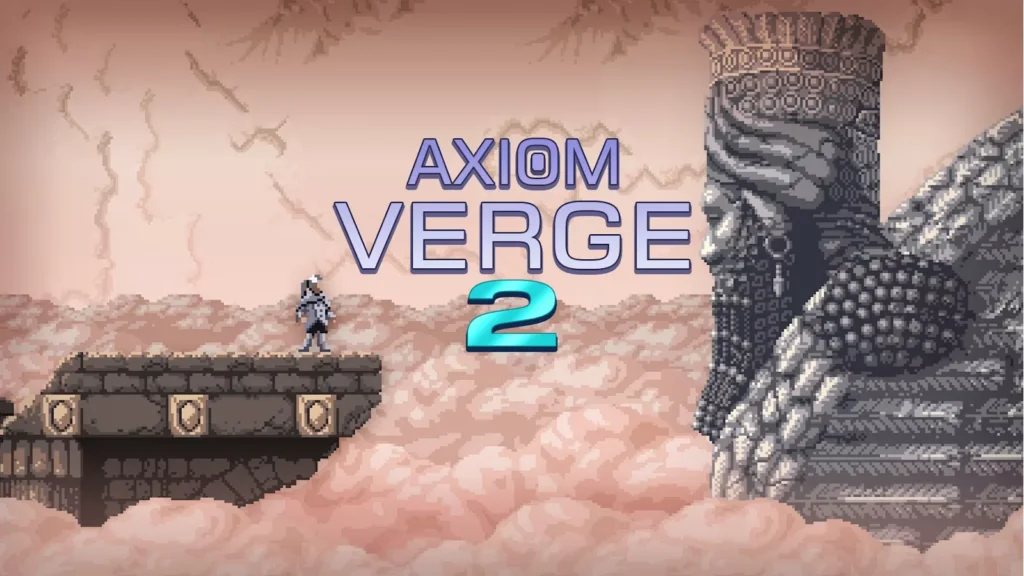
Axiom Verge 2 has a colder and more organic visual identity than the first game. The original leaned strongly into biomechanical horror, glitch aesthetics, alien laboratories, and corrupted machinery. The sequel still belongs to that universe, but it expands the palette: snowfields, ruins, industrial zones, subterranean passages, ancient structures, and digital spaces build a world that feels less like a single alien nightmare and more like a layered archaeological mystery.
The pixel art is not merely decorative. It serves the exploration. Background shapes, terrain silhouettes, destructible-looking surfaces, and technological objects constantly suggest that the map contains more than it reveals. The best moments happen when the player sees a route, cannot reach it yet, and mentally stores it for later. This visual readability is crucial in a game that asks the player to think spatially.
The art direction also benefits handheld play. On a larger Switch 2 screen, the game’s clean tilework and compact UI remain readable. It does not chase spectacle, but it does maintain a strong identity. The environments are often beautiful in a restrained way, especially when the game contrasts natural landscapes with unnatural machinery.
However, the sequel can feel visually less immediately iconic than the first Axiom Verge. The first game’s grotesque alien imagery was more aggressive and memorable at a glance. Axiom Verge 2 is subtler, which suits its exploratory design, but some areas can feel less striking during long sessions. Its visual personality is strong, but quieter.
Combat
Combat is the most controversial part of Axiom Verge 2. This is not a sequel built around expanding the arsenal of the first game. Instead of turning the player into a walking science-fiction weapon rack, it pushes melee attacks, hacking tools, drone abilities, and environmental interaction. That change is brave, but not always satisfying.
Basic encounters can feel functional rather than exciting. Enemies often exist as obstacles, pressure points, or hacking opportunities rather than as mechanically rich opponents. The hacking system is conceptually excellent: altering enemy behavior, disabling systems, or manipulating objects gives the game a distinct identity. Destructoid highlighted hacking as a major part of the experience, noting that it can be used to alter objects and enemies in useful ways.
The issue is that combat rarely achieves the tension or punch expected from the genre’s best action-focused entries. Boss fights are especially muted. Several critical discussions around the game point to underwhelming boss encounters and simplified combat as recurring weaknesses. IGN’s review summary, quoted in a review thread, described the game as engaging to explore despite one-dimensional combat and weak boss fights.
This does not ruin the game, because Axiom Verge 2 is not primarily trying to be a combat showcase. But it does limit its ceiling. Players who loved the first game for its weapons, bosses, and hostile alien pressure may find this sequel less immediately rewarding. Its combat works best when treated as part of traversal and problem-solving, not as the main attraction.
Exploration & World Design
Exploration is the reason Axiom Verge 2 matters. This is where the sequel becomes genuinely confident. The map is dense, layered, and deliberately constructed around curiosity. Progression depends not only on finding upgrades but on learning how the world thinks.
The official press kit describes Axiom Verge 2 as a 2D Metroidvania action-adventure with new characters, abilities, enemies, and a new world, while also emphasizing that Tom Happ handled the music, art, game design, and programming. That one-person authorship is visible in how interconnected the world feels. There is a coherent design logic behind its strangeness.
The most important structural idea is the relationship between different layers of reality. The game does not simply give the player a bigger map; it asks the player to reconsider what the map is. Alternate spaces, hidden paths, drone routes, and ability gates create a strong sense of spatial re-interpretation. The best discoveries feel earned because they emerge from observation rather than direct instruction.
Nintendo Life praised the game’s mysterious atmosphere, pace, and world design, calling it a worthy follow-up that stands on its own. Nintendo World Report similarly framed it as a strong evolution of the first game, especially because of its addictive exploration and beautiful vistas. Those assessments capture the game’s strongest quality: it understands that Metroidvania exploration is not only about collecting keys for locks, but about changing the player’s relationship with space.
Still, Axiom Verge 2 can be obscure. Wayfinding is sometimes intentionally indirect, and not every player will enjoy that. The game expects patience. It trusts the player to wander, experiment, and occasionally feel lost. For fans of exploration-heavy design, that is part of the appeal. For players who prefer clearer objective chains, it can become friction.
Movement & Controls
Movement in Axiom Verge 2 is solid, but it is not as instantly fluid or expressive as the best modern Metroidvanias. This is not Ori and the Will of the Wisps, Prince of Persia: The Lost Crown, or Metroid Dread. It is slower, more deliberate, and more tool-based.
That said, movement improves as the ability set expands. The early game can feel plain, especially because combat does not provide much kinetic excitement. Once the drone and later traversal tools become central, the game’s movement identity becomes more interesting. The player is not just moving faster; they are accessing the world through different forms, sizes, and rules.
Controls are responsive enough for exploration, platforming, and basic combat. On Nintendo Switch 2, the experience benefits from the system’s improved ergonomics compared to the original Joy-Con setup, especially during longer handheld sessions. The game does not require extreme precision most of the time, so it fits portable play well.
The main limitation is that movement rarely feels spectacular. It is intelligent rather than thrilling. The pleasure comes from reaching places, not necessarily from the physical act of movement itself. That distinction is important. Axiom Verge 2 is a strong exploration game, but not a top-tier movement game.
Difficulty & Progression
Axiom Verge 2 is not especially difficult in the traditional combat sense. Its challenge comes from navigation, interpretation, and understanding how abilities interact with the environment. This makes it less punishing than many combat-heavy Metroidvanias, but not necessarily easier for every player.
The progression system is thoughtful because upgrades often have multiple implications. A new ability may open an obvious gate, but it may also change how the player thinks about earlier rooms. This is where the game feels closest to classic Metroid design: the map becomes richer retroactively.
However, progression can occasionally feel uneven. Because combat is less central and bosses are less dramatic, some upgrades do not carry the same emotional weight they would in a more action-oriented game. The player becomes more capable, but not always more powerful in a satisfying way. This supports the game’s exploratory identity, yet it may disappoint players expecting a stronger escalation curve.
The difficulty is therefore intellectual and spatial more than reflexive. The game rewards patience, memory, and curiosity. It punishes rushing less through death and more through confusion.
Story & Atmosphere
The story follows Indra Chaudhari, a billionaire connected to the Globe 3 conglomerate, who is drawn into a strange world while searching for her missing daughter. The official site presents the game as part of the same story as the original _Axiom Verge_, but with a new character, new powers, new enemies, and a new world.
Narratively, Axiom Verge 2 is cryptic, fragmented, and more concerned with implication than exposition. It uses science fiction, ancient technology, parallel realities, and identity questions to create a sense of intellectual unease. The game’s atmosphere is less horrific than the first entry but arguably more mysterious.
This approach works well when the player is exploring ruins, reading between environmental details, or piecing together the implications of the world. It works less well when emotional stakes are expected to carry the experience. Indra’s motivation gives the story a personal hook, but the game remains more fascinating as world-building than as character drama.
The atmosphere is one of the sequel’s strongest achievements. It feels lonely, alien, and archaeological. The game does not overexplain itself, which keeps the world intriguing. But that same restraint may leave some players emotionally distant.
Soundtrack & Audio Design
Tom Happ’s soundtrack is once again central to the identity of the game. The music supports mystery more than adrenaline. It uses ambient textures, retro tones, and melodic fragments to make exploration feel contemplative.
The audio design is effective because it does not overpower the game. This is not a soundtrack that constantly demands attention. Instead, it reinforces the feeling of entering spaces that are older, stranger, and more complex than the player initially understands.
Compared with the first game, the sequel’s music may feel less immediately memorable for some players, but it fits the new design philosophy. Since Axiom Verge 2 is less about combat pressure and more about environmental discovery, the soundtrack wisely leans into mood and unease.
In handheld mode, the audio experience is still strong with headphones. The game is a good fit for portable play because its atmosphere survives small-screen sessions without needing cinematic volume or visual spectacle.
Nintendo Switch Performance Analysis
Handheld Mode
In handheld mode, Axiom Verge 2 is a natural fit. The pixel art remains readable, the UI is simple, and the compact file size makes it an easy game to keep installed. Nintendo lists the game as supporting handheld mode and a 432 MB file size for both Switch and Switch 2 listings.
On Switch 2, the larger display helps the game more than raw power does. Fine details are easier to parse, and the map-heavy nature of the experience benefits from better screen real estate. This is especially useful because Axiom Verge 2 often asks the player to read room shapes, remember blocked paths, and examine routes.
Visual clarity is strong. UI readability is good. The portable experience is excellent for short exploration sessions, although the game’s cryptic structure sometimes makes it better suited to focused play rather than distracted commuting.
Docked Mode
Docked mode presents the game cleanly, though the visual style remains intentionally retro. This is not a game that transforms dramatically on a large screen. The pixel art scales well enough, and the environments retain their atmosphere, but the experience arguably feels more intimate in handheld mode.
On a TV, the world design becomes easier to appreciate as a full spatial structure. The contrast between environments, ruins, and technological spaces is clearer. However, the game’s relatively restrained animation and combat mean docked play does not add the same sense of spectacle that it might for a more visually ambitious action platformer.
Image quality is solid for the type of game it is. There is no confirmed native Switch 2 enhancement, so players should not expect a remaster-like presentation.
Performance Metrics
Official technical specifications for Axiom Verge 2 on Nintendo Switch do not publicly provide detailed FPS, frame pacing, resolution, input lag, or loading-time metrics. Because of that, this review avoids inventing exact numbers.
Available community discussion points toward generally smooth performance, with some players reporting 60 FPS with occasional hitches on Switch. Other pre-release/community discussion around frame rate also reflects sensitivity to whether the Switch version targeted 30 FPS or 60 FPS, but these are not official benchmarks.
In practical terms, Axiom Verge 2 feels technically appropriate for Nintendo Switch hardware and even more comfortable on Switch 2 through compatibility. During normal play, its performance profile is not the main issue. The game’s limitations are design-related — combat, boss intensity, and wayfinding — rather than technical.
Known technical assessment:
- FPS: no official published FPS target confirmed in Nintendo listing.
- Frame pacing: generally perceived as stable, with some community reports of occasional hitches.
- Stuttering: not a widespread defining issue in critical consensus.
- Loading times: not commonly cited as a major problem.
- Crashes: no major crash pattern appears central to the game’s reputation.
- Bugs: no major Switch-specific bug pattern dominates critical discussion.
- Input lag: no widely documented input-lag issue, and controls feel responsive for exploration.
- Resolution: no official Switch/Switch 2 resolution specification found in Nintendo listing.
Port Quality Assessment
The Nintendo Switch version of Axiom Verge 2 should be considered a solid port. On Switch 2, it remains a comfortable way to play the game, especially in handheld mode. The game is lightweight, readable, and structurally well suited to portable exploration.
The port does not appear to be technically ambitious, but it does not need to be. Its success depends on stability, clarity, and responsiveness. Based on available information and critical consensus, the Switch experience supports the game’s design effectively.
Port quality rating: solid.
Genre Positioning
Axiom Verge 2 is a Metroidvania, but more specifically it is an exploration-heavy, systems-driven Metroid-like with reduced emphasis on combat. It is not an Igavania in the loot/stat/progression sense, nor is it a soulslike-inspired Metroidvania. It is closer to a classic exploratory action-adventure that uses ability gating, layered maps, and environmental logic as its foundation.
Its most important genre distinction is that it rejects the expectation that a sequel must intensify combat. In the current Metroidvania landscape, where many games compete through boss fights, parry systems, precision platforming, or RPG builds, Axiom Verge 2 stands apart by making curiosity the main verb.
That makes it valuable for genre fans, even if it is imperfect. It is the kind of Metroidvania that deepens the field rather than simply polishing familiar formulas. It may not satisfy players looking for constant action, but it deserves attention from anyone interested in world structure, sequence exploration, hidden routes, and unconventional progression.
Critical consensus reflects that divide. OpenCritic lists Axiom Verge 2 with a Strong rating, a 78 average, and 74% critic recommendation, while Metacritic lists the Nintendo Switch version with generally favorable reviews and a 76 Metascore. That is a fair summary of the game’s place in the genre: respected, ambitious, and divisive.
Veredict
Axiom Verge 2 is a fascinating sequel because it chooses transformation over repetition. It is not simply more _Axiom Verge_. It is stranger, quieter, more exploratory, and less interested in traditional action satisfaction. That makes it both more original and more uneven.
Its world design is excellent. Its atmosphere is strong. Its layered exploration gives it a genuine identity within the Metroidvania genre. The hacking mechanics and drone-based progression add meaningful texture, and the game rewards players who enjoy getting lost, studying maps, and rethinking old spaces after gaining new abilities.
At the same time, its combat lacks impact, its bosses are underwhelming, and its progression can feel emotionally flat compared with more combat-driven peers. Players who come expecting the first game’s arsenal-heavy intensity may leave disappointed. Players who value exploration above all else will find much more to appreciate.
On Nintendo Switch, Axiom Verge 2 remains a strong portable Metroidvania experience through the Switch version. It does not need a native technical upgrade to work well, but it also does not gain much beyond comfort, clarity, and convenience. Its real achievement is design, not performance.
Score 8/10
Axiom Verge 2 is an intelligent, exploration-first Metroidvania that sacrifices combat intensity for world design, mystery, and structural ambition.