

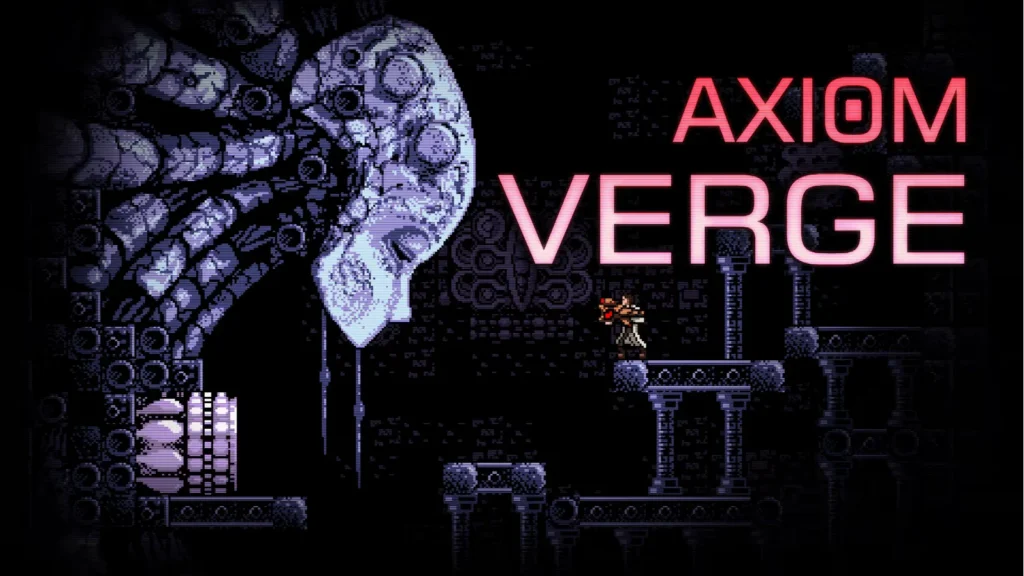
A strange, hostile, and essential Metroid-like for portable play
Axiom Verge is one of those games that feels impossible to discuss without invoking Metroid, but reducing it to imitation would be unfair. It is clearly built from the genetic material of classic exploratory action games, especially the more alien side of Nintendo’s lineage, yet it develops its own identity through biomechanical horror, weapon experimentation, glitch-based mechanics, and an unsettling sense that the world itself is broken.
On Nintendo Switch, Axiom Verge remains one of the most important indie Metroidvania releases available on the platform. It is not the smoothest, most modern, or most accessible entry in the genre, but it is one of the most historically significant. Long before the Switch became a natural home for indie Metroidvanias, Axiom Verge helped define what a solo-developed, exploration-driven action game could achieve when it understood the language of the classics without simply copying their surface.
Its biggest strength is atmosphere through mechanics. This is not just a game about exploring rooms, finding upgrades, and unlocking new paths. It is a game about entering an unstable alien system, learning its rules, then slowly discovering that those rules can be corrupted. The result is a Metroid-like that feels familiar in structure but genuinely weird in texture.
For players coming from Hollow Knight, Ori, Metroid Dread, or Prince of Persia: The Lost Crown, Axiom Verge may feel older, harsher, and less polished in movement. But for players interested in the roots of the genre, the design language of Super Metroid, and the strange beauty of hostile alien worlds, it remains highly relevant.
Visual Presentation
Axiom Verge uses pixel art not as nostalgia wallpaper, but as a design language. Its world is full of organic machinery, distorted alien architecture, biomechanical enemies, corrupted environments, and visual details that suggest a civilization long past the point of normal understanding. The game often looks like a lost 16-bit sci-fi horror cartridge from an alternate timeline.
The art direction is strongest when it leans into discomfort. Environments are not beautiful in a clean or decorative sense. They are strange, fungal, metallic, biological, and hostile. The visual identity communicates that Trace has not simply entered a dangerous world; he has entered a world that does not care whether he understands it.
That said, the visual presentation is deliberately old-school. Players who prefer the animated richness of Ori and the Will of the Wisps or the crisp modern readability of Metroid Dread may find Axiom Verge visually stiff. Character animation is functional rather than expressive, and some rooms can feel visually dense. The game also relies heavily on retro abstraction, meaning that mood often matters more than fine detail.
On Switch, the pixel art holds up very well in handheld mode because the smaller screen gives the image a compact, readable quality. The visual style is also well suited to quick portable sessions, since rooms, enemy silhouettes, and environmental boundaries are usually easy to parse. Docked mode exposes the simplicity of some assets more clearly, but the art direction remains coherent.
Axiom Verge is not a showcase of technical spectacle. It is a showcase of aesthetic commitment.
Combat
Combat in Axiom Verge is built around firearms, enemy patterns, positioning, and experimentation. Unlike melee-centered Metroidvanias, this is a shooter at its core. Trace collects a large arsenal of weapons, many with unusual firing behaviors, spread patterns, range limitations, or utility value.
This variety is one of the game’s defining strengths. The player is encouraged to test weapons not only for raw damage, but for how they interact with enemy placement and room geometry. Some weapons are better for narrow corridors, others for enemies above or below the player, and others for bosses or clustered threats. The combat has an exploratory quality because the arsenal itself becomes part of the discovery loop.
The famous Address Disruptor, a glitch-like tool that can corrupt enemies and alter certain environmental objects, gives Axiom Verge one of its most memorable mechanics. It fits the game’s fiction beautifully: you are not merely upgrading yourself, you are interfering with the logic of the world. When this mechanic works well, it gives combat and exploration a flavor that few other Metroidvanias share.
However, combat is not always elegant. Some enemy placements can feel abrasive, and certain encounters rely more on attrition than tactical depth. Boss fights are visually memorable but uneven mechanically. A few are exciting tests of pattern recognition and weapon choice, while others feel more chaotic than refined.
The game’s shooting is responsive enough, but it does not have the fluidity of later genre entries. Players used to more modern movement tech may initially find Trace slightly rigid. Still, within the design language Axiom Verge is using, the combat works. It is not graceful, but it is tense, strange, and aggressive.
Exploration & World Design
Exploration is the heart of Axiom Verge, and it is where the game most clearly earns its reputation. The world is structured around classic ability-gated progression: you enter unfamiliar regions, hit barriers, discover tools, reinterpret earlier spaces, and slowly assemble a mental map of how everything connects.
The game understands the pleasure of suspicion. A wall may not just be a wall. A strange object may not just be decoration. A corrupted enemy may have a purpose beyond being defeated. This constant uncertainty gives exploration a strong investigative rhythm.
Axiom Verge also rewards curiosity with meaningful upgrades. Weapons, health expansions, range upgrades, lore notes, and progression tools are hidden across the map. The world is not as elegantly interconnected as Super Metroid, nor as densely layered as Hollow Knight, but it has a strong sense of alien sprawl. You are meant to feel lost, then gradually competent.
The weakness is that navigation can become obscure. Some progression points are less intuitive than others, and backtracking can feel heavier than in more modern Metroidvanias. The map helps, but it does not always solve the issue of remembering which strange barrier corresponds to which strange tool. This is part of the old-school identity, but it can also slow the pacing.
Still, Axiom Verge succeeds because its world feels designed around discovery rather than checklist completion. It wants the player to poke, test, shoot, corrupt, and revisit. In a genre increasingly filled with smooth but predictable maps, that sense of uncertainty remains valuable.
Movement & Controls
Movement in Axiom Verge is functional, deliberate, and historically grounded. Trace does not move like a modern acrobatic protagonist. He jumps, shoots, climbs, upgrades, and gradually gains new traversal options, but his baseline feel is closer to older action-platformers than to contemporary movement-heavy Metroidvanias.
This is both a strength and a limitation. The slower, more grounded movement supports the game’s hostile atmosphere. Trace feels vulnerable, and the world feels dangerous. When new abilities expand his movement, they matter because the starting point is restrained.
However, the controls can feel stiff when compared to later Switch genre highlights. Players who expect air dashes, wall mobility, cancel windows, or high-speed combat flow may need time to adjust. Axiom Verge is not trying to be a movement playground. It is trying to be an exploratory shooter with deliberate platforming.
The Nintendo Switch controls work well. Button response feels solid, and the game is especially comfortable in handheld mode because short exploration sessions fit the structure naturally. The control scheme is readable and practical, though the growing weapon inventory can make experimentation slightly cumbersome until the player becomes familiar with favorites.
Overall, Axiom Verge controls well for what it is, but it should not be evaluated as if it were a post-Hollow Knight movement system. Its design belongs to an older tradition.
Difficulty & Progression
xiom Verge has a moderate-to-high difficulty curve, depending on how thoroughly the player explores. Players who search for upgrades, experiment with weapons, and learn boss behaviors will find the challenge manageable. Players who rush forward with limited health and few optional upgrades may find certain sections punishing.
The game’s difficulty comes from several sources: enemy density, projectile patterns, boss damage, obscure navigation, and the need to interpret unusual mechanics. It is rarely unfair in a modern sense, but it can be abrasive. Some rooms feel designed to wear the player down rather than provide elegant tactical encounters.
Progression is satisfying because upgrades often change how the player understands the world. A new tool is not just a key; it is a new way of reading the environment. This is one of the strongest aspects of the game’s design. Axiom Verge understands that in a good Metroidvania, progression should affect perception, not only access.
The pacing can occasionally suffer from uncertainty. When the player does not know where to go next, the game may become a process of revisiting old regions and testing possibilities. For some players, this is the essence of the genre. For others, especially those used to more guided modern games, it may feel frustrating.
Axiom Verge respects the player’s intelligence, but it does not always respect the player’s time equally.
Story & Atmosphere
The story begins with Trace, a scientist who awakens in a strange alien world after a catastrophic accident. From there, Axiom Verge builds a narrative full of ancient war, biomechanical beings, unreliable reality, technological corruption, and metaphysical uncertainty.
The writing is not always emotionally powerful, but the premise is compelling. The game is more successful as atmosphere than as character drama. Its best storytelling comes from the relationship between environment, enemy design, strange terminology, and the sense that the world operates according to rules the player only partially understands.
This is where Axiom Verge separates itself from simpler retro tributes. It does not merely imitate the loneliness of Metroid; it amplifies it through a kind of digital body horror. The world feels diseased, but not dead. It feels intelligent, but not welcoming. It feels ancient, but also technological.
The result is one of the strongest sci-fi atmospheres in the indie Metroidvania space. The game may not deliver a deeply human story, but it delivers a memorable world. For this genre, that matters enormously.
Soundtrack & Audio Design
The soundtrack, composed by Tom Happ, is one of Axiom Verge’s defining achievements. It combines retro synth textures, alien melodies, pulsing rhythms, and unsettling ambience to reinforce the game’s strange identity.
The music does not simply sit behind the action. It gives each region a distinct emotional signature. Some tracks feel urgent and mechanical, while others feel lonely, mysterious, or almost ritualistic. The audio design strengthens the sense that the world is not natural, but also not purely artificial.
Sound effects are sharp and readable. Weapons have distinct audio identities, enemy attacks communicate danger clearly enough, and the glitch mechanics are supported by effects that feel appropriately unstable.
Like the visuals, the soundtrack is retro-inspired without feeling lazy. It understands the emotional language of older hardware aesthetics, then uses that language to create unease rather than simple nostalgia.
Nintendo Switch Performance Analysis
Handheld Mode
Handheld mode is arguably the best way to play Axiom Verge on Nintendo Switch. The pixel art looks clean on the smaller screen, the UI remains readable, and the compact display helps the retro presentation feel focused rather than sparse.
The game’s structure also suits portable play. Exploration can be divided into short sessions: clear a few rooms, test a new upgrade, find a save point, revisit an old path, or attempt a boss. Axiom Verge does not require the cinematic attention of a large-screen experience, which makes it a strong fit for the Switch’s portable identity.
Visual clarity is generally strong. Enemy silhouettes, platforms, projectiles, and room boundaries remain easy to understand. Some darker or busier environments may require more attention, but this is more a product of art direction than a Switch-specific issue.
Stability in handheld mode is solid. There are no major recurring performance problems that define the port today. Earlier reports around the Switch version mentioned some quirks that were improved through updates, and the current experience is generally reliable.
Docked Mode
Docked mode presents Axiom Verge clearly, though it is less flattering to the game’s retro assets. On a larger TV, the pixel art remains stylistically consistent, but some visual simplicity becomes more noticeable. This does not harm playability, but it does slightly reduce the intimacy that handheld mode provides.
Image quality is clean enough for a retro 2D title. The game does not depend on high-resolution detail, complex effects, or modern lighting, so docked mode is mostly about whether the pixel art scales well. In general, it does.
TV performance is stable and responsive. The game feels comfortable with a Pro Controller or Joy-Con setup, and there are no major control-related issues unique to docked play.
Performance Metrics
Axiom Verge on Nintendo Switch targets a mostly steady 30 frames per second. Reports on the Switch version describe performance as generally stable, with native-resolution presentation and only minor visual compromises such as lower-resolution shadows. The game is not a 60 FPS showcase, but it does not need to be one to preserve its intended feel.
Frame pacing is generally acceptable. Axiom Verge is not a game built around ultra-fast animation priority or precision combat on the level of Metroid Dread, so the 30 FPS presentation does not significantly damage the experience. Input response feels solid for exploration, shooting, and platforming.
Loading times are reasonable and do not meaningfully interrupt the flow. The small file size and 2D structure help the game feel lightweight on the system.
Crashes, major bugs, and severe stuttering are not defining issues of the current Switch version. Older discussion around the port mentioned save-related quirks near launch, but those issues were reportedly improved with patches. Based on the current state of the game, the Switch version can be considered dependable.
Port Quality Assessment
The Nintendo Switch port of Axiom Verge is solid.
It is not a technically ambitious port, and it does not transform the game beyond its original identity. However, it preserves the core experience well, works naturally in handheld mode, and provides a stable way to play one of the most important indie Metroidvanias of the last decade.
The main limitation is the 30 FPS presentation, which may disappoint players who strongly prefer 60 FPS in 2D action games. Even so, the game remains responsive enough for its design. For most players, the portability benefit outweighs the technical limitations.
Port quality assessment: solid.
Genre Positioning
Axiom Verge is best understood as a Metroid-like rather than a broad Castlevania-style Metroidvania. Its design priorities are exploration, shooting, alien atmosphere, ability gating, map reinterpretation, and environmental mystery. It has far more in common with Metroid, Super Metroid, and retro sci-fi action-platformers than with Igavania RPG systems.
It is not an Igavania. There is no loot-driven RPG loop, no leveling system in the Castlevania: Symphony of the Night sense, and no emphasis on equipment builds. It is also not a soulslike-inspired Metroidvania. Its challenge comes from hostile rooms, boss patterns, and exploration friction, not corpse runs or stamina management.
Genre Classification
Metroid-like, exploration-heavy, retro action-platformer, sci-fi horror Metroidvania.
Within the genre, Axiom Verge occupies a historically important position. It helped prove that an indie developer could produce a dense, credible, mechanically distinct Metroidvania with a strong authorial voice. It is less polished than some later masterpieces, but its influence is obvious.
For Casualvania readers, this is essential context: Axiom Verge is not merely another good Switch Metroidvania. It is one of the games that helped prepare the ground for the modern indie Metroidvania boom.
Veredict
Axiom Verge remains an essential Nintendo Switch Metroidvania, not because it is flawless, but because it understands the core pleasures of the genre with unusual clarity. It captures the loneliness, uncertainty, and satisfaction of exploring a hostile alien world, then adds its own identity through glitch mechanics, strange weapons, and oppressive sci-fi atmosphere.
Its weaknesses are real. Movement can feel stiff by modern standards, some combat encounters are uneven, progression can become obscure, and the Switch version is limited to a mostly steady 30 FPS presentation rather than the smoother feel some players may expect from 2D action games today.
But its strengths matter more. The world is memorable. The soundtrack is excellent. The weapon variety gives combat personality. The exploration loop remains compelling. Most importantly, Axiom Verge still feels authored. It has a specific vision, a specific texture, and a specific kind of weirdness that many cleaner games lack.
On Nintendo Switch, it is a strong portable experience and a valuable part of any Metroidvania library. Players looking for modern fluidity may prefer Metroid Dread, Hollow Knight, Ori, or Prince of Persia: The Lost Crown. Players who want a strange, classic, exploration-heavy Metroid-like should not skip Axiom Verge.
Score 8.5/10
Axiom Verge is a strange, influential, and deeply committed Metroid-like that still deserves a place on Nintendo Switch, especially for players who value atmosphere, discovery, and retro sci-fi design over modern smoothness.