

A puzzle-box Metroidvania where curiosity matters more than combat
Animal Well is one of those games that seems simple only until you start paying attention. At first glance, it looks like another compact pixel-art indie Metroidvania: a small creature wakes inside a strange underground world, rooms connect through locked paths, and new tools gradually open new routes. But that surface description barely explains what makes the game special. Animal Well is not built around combat escalation, damage numbers, skill trees, or boss mastery. It is built around observation.
Developed by Billy Basso under Shared Memory and published by Bigmode, Animal Well was released on Nintendo Switch, PlayStation 5, and PC on May 9, 2024. The game presents itself as a dense, atmospheric puzzle-box world filled with layered secrets, multi-use items, unusual creatures, and a custom engine designed specifically for modern pixel art. That description is accurate, but still modest: Animal Well feels less like a game that wants to explain itself and more like a strange object found in the dark, inviting the player to test every surface, every sound, and every behavior.
Within the Metroidvania space, Animal Well is important because it challenges what fans usually expect from the genre. Progression exists, backtracking matters, the map is interconnected, and tools reshape navigation. But its real identity sits closer to puzzle exploration than action-platforming. This is a Metroidvania for players who enjoy getting lost, marking suspicious rooms, testing strange item interactions, and realizing hours later that an object they already had could solve a problem in a completely different way.
That makes it a fascinating Nintendo Switch game. It is compact enough for short handheld sessions, mysterious enough to occupy long evenings, and technically stable enough that the hardware rarely gets in the way of the experience. For Casualvania, Animal Well is not just another acclaimed indie release; it is one of the clearest examples of how the Metroidvania formula can still evolve without becoming bigger, louder, or more combat-heavy.
Visual Presentantion
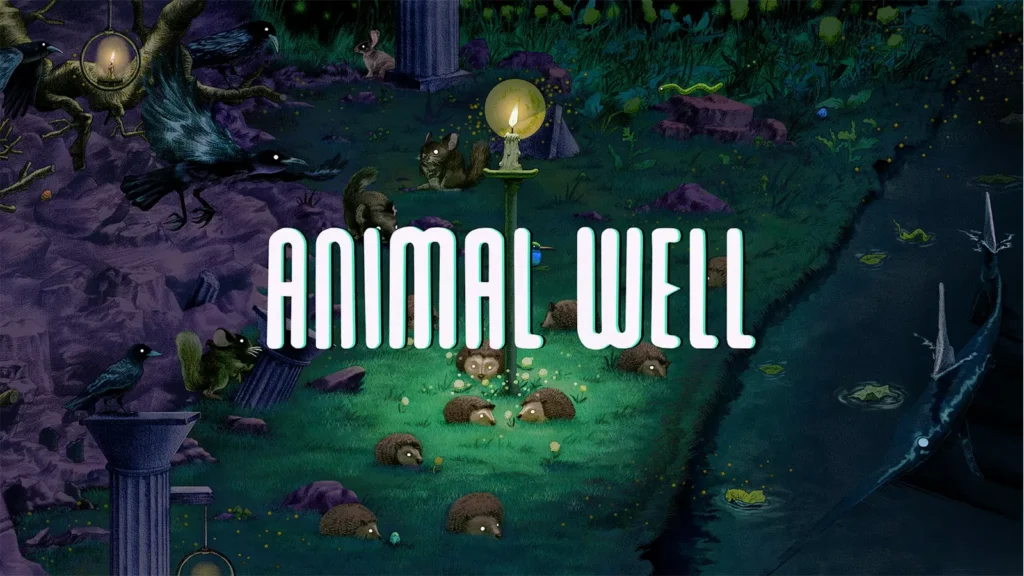
Animal Well is visually restrained, but not simple. Its pixel art avoids the clean, high-definition polish common in many modern indie games and instead builds its identity around darkness, glow, silhouette, scanline texture, and negative space. Rooms often feel like small dioramas lit by dim lamps, water reflections, firecrackers, candles, and strange organic shapes. The result is a game that looks old in vocabulary but modern in execution.
The most impressive aspect is how much atmosphere the game extracts from limited visual language. The world is not overloaded with detail, yet every screen feels intentional. Background depth, soft lighting, particle effects, and careful contrast make the well feel alive without making it visually noisy. This matters especially on Nintendo Switch OLED, where the game’s deep blacks and lighting effects become part of the experience rather than just decoration.
On Nintendo Switch, Animal Well is a dark game, but it is not visually muddy. Its use of contrast makes rooms readable while still preserving mystery. The small protagonist remains easy to track, interactable elements usually stand out clearly, and the visual design supports exploration rather than fighting against it. There are moments where the environment becomes deliberately obscure, but that obscurity is usually part of the game’s language, not a technical flaw.
The CRT-style scanline filter is also part of the visual identity. Some players will love the texture because it gives the image a soft, analog quality. Others may prefer disabling it for a cleaner look, especially in docked mode. The important point is that Animal Well gives the player enough visual clarity and stylistic control to make the experience comfortable across different displays.
Animal Well’s visual achievement is not that it has the most detailed pixel art in the genre. It is that every visual choice reinforces the same emotional idea: you are small, the world is old, and every screen may be hiding something.
Combat
Animal Well barely has combat in the traditional sense. That may be its most divisive design choice.
The protagonist cannot attack in the usual Metroidvania way. There is no sword, gun, spell rotation, combo system, parry window, or damage-based progression. Instead, hostile creatures are treated as environmental forces. Some chase you, some block routes, some react to items, and some become parts of puzzles. Survival is based on movement, timing, distraction, avoidance, and understanding behavior.
This is where Animal Well separates itself from Hollow Knight, Blasphemous, Metroid Dread, Axiom Verge, or any Igavania-style progression system. The game is not interested in making the player stronger through combat mastery. It is interested in making the player smarter through interaction.
Many boss-like encounters function more as environmental puzzles than conventional fights. A dangerous animal is not merely an enemy; it is a rule set. The question is not “how do I kill this?” but “what does this creature respond to?” That design decision gives Animal Well a strong identity, but it also means the game can feel unusually indirect for players who expect action-heavy progression.
This approach is bold, but it will not satisfy every Metroidvania fan. Players who come to the genre for weapon upgrades, build variety, damage optimization, and boss duels may find Animal Well too passive. Some encounters can also feel uneven because the game occasionally asks for precise timing without giving the catharsis of direct retaliation.
Still, the absence of traditional combat is not a weakness by itself. It is the core design commitment. Animal Well is a game about interpreting a world, not conquering it.
Exploration & World Design
Exploration is the heart of Animal Well, and it is exceptional.
The world is structured as a dense network of rooms, routes, secrets, shortcuts, and layered discoveries. It uses familiar Metroidvania principles: new items unlock new possibilities, previously visited rooms gain new meaning, and the map becomes a mental object as much as a navigational tool. But Animal Well’s progression feels less like acquiring keys and more like learning a language.
Many items have multiple uses. A tool that seems designed for one puzzle may later become a traversal aid, a creature manipulator, or a way to trigger something from a distance. This gives the game a strong “wait, can I use it like that?” quality. The best discoveries often emerge from experimentation rather than explicit instruction.
The map system supports this kind of thinking. Animal Well lets players mark locations of interest, including suspicious areas, candles, collectibles, and unresolved puzzles. This is important because the game often expects the player to remember strange details. A room may not make sense now, but it may matter later. A sound cue may seem atmospheric until it becomes information. A creature may seem decorative until its behavior reveals a route.
Backtracking is present, but it generally feels purposeful. The game rarely gives the player a simple checklist. Instead, it creates a sense that every return trip could reveal something missed. That said, the experience can become cryptic. Players who dislike ambiguity may occasionally feel stuck, not because they lack execution, but because they have not made the correct conceptual connection.
This is where Animal Well becomes both brilliant and demanding. It respects the player’s intelligence, but it also assumes a willingness to experiment without constant reassurance. For the right player, that is thrilling. For the wrong player, it may feel opaque.
Movement & Control
Animal Well’s controls are simple, responsive, and carefully tuned around its puzzle-platforming priorities. Movement is not as acrobatic as Ori and the Will of the Wisps, not as sharp and combat-ready as Hollow Knight, and not as aggressive as Metroid Dread. It has a smaller physical vocabulary, but that vocabulary is reliable.
The protagonist’s jump has enough weight to make platforming feel deliberate. Screen-to-screen transitions are quick, and the game benefits greatly from its compact room structure. This helps the rhythm of exploration because moving from one area to another feels immediate rather than heavy.
The controls are also forgiving in a smart way. Failed platforming often resets the player nearby rather than harshly punishing every mistake. This matters because Animal Well is not trying to be a precision punishment platformer. It can demand timing, but its main challenge is interpretation. The game wants the player thinking, not constantly repeating long punishment loops.
On Switch, the control feel works well in both handheld and docked modes. The interface is minimal, button demands are reasonable, and the game does not require the kind of rapid multi-button combat execution that can sometimes feel cramped on Joy-Con. This makes it especially comfortable as a portable puzzle-exploration game.
Difficulty & Progression
Animal Well’s difficulty is unusual because it is not mainly mechanical. Yes, there are platforming challenges, chase sequences, hostile creatures, and boss-like encounters. But the deeper difficulty comes from uncertainty.
The game does not over-explain. It trusts the player to notice patterns, test items, and infer meaning. This creates some wonderful moments of discovery. Solving a puzzle in Animal Well can feel less like completing a designed obstacle and more like realizing you have misunderstood the game’s rules for the last hour.
Progression is layered. The main route is approachable enough for dedicated players, but completion becomes increasingly obscure. Some secrets are direct, others are cryptic, and some seem designed for long-term community discussion. This gives Animal Well a rare post-game identity: it is not just about collecting everything, but about participating in an ongoing mystery.
The downside is that the game can become less satisfying for players who prefer clear goals. Some secrets are subtle enough that many players will either miss them entirely or eventually consult external help. That is not necessarily bad design, but it does define the audience. Animal Well rewards patience, curiosity, note-taking, and tolerance for ambiguity.
Story & Atmosphere
Animal Well has almost no explicit story, and that is the correct choice for this game.
There is no heavy exposition, no major cast of speaking characters, no lore archive constantly explaining the world, and no emotional monologue telling the player how to feel. Instead, atmosphere does the work. The world suggests meaning without resolving it. The animals feel symbolic without becoming obvious. The well itself feels ancient, artificial, natural, and dreamlike all at once.
This absence of conventional narrative gives the game its identity. You are not moving through Animal Well to watch a plot unfold. You are moving through it because the world keeps asking silent questions. Why is this room here? Why does this creature behave this way? Why does this item work in one place and not another? Why does the world feel playful and threatening at the same time?
That tension is essential. Animal Well is not horror in a conventional genre sense, but it borrows from horror through sound, darkness, pursuit, vulnerability, and uncertainty. Some creatures feel almost cute. Others feel dangerous in the way wild animals are dangerous. A few moments shift into genuine unease, not because the game becomes violent, but because it makes the player feel small and exposed.
The result is one of the most distinctive atmospheres in modern Metroidvania-adjacent design. It is mysterious without becoming vague for its own sake, cute without being cozy, and eerie without relying on cheap shock.
Soundtrack & Audio Design
Animal Well’s sound design is one of its strongest achievements. This is not a game driven by a constant melodic soundtrack. Instead, it uses environmental audio, creature sounds, subtle tones, water, echoes, and sharp effects to make each room feel alive.
The best audio moments are small. A creature movement in the dark. A sudden reaction to an item. The soft confirmation that something changed off-screen. These sounds reinforce the game’s core loop of observation. In many Metroidvanias, audio supports combat and spectacle. In Animal Well, audio supports suspicion.
The game’s quietness is part of its design. Silence gives weight to small noises. Water drops, rustling plants, animal calls, and sudden effects create a sense that the world is reacting even when the player does not fully understand why. This makes the environment feel less like a static map and more like a living system.
Animal Well is also an excellent headphone game in handheld mode. Playing quietly on Switch with headphones can make the world feel more intimate and more unsettling. The audio design is precise enough that portable play does not reduce the experience; in some ways, it strengthens it.
Nintendo Switch Performance Analysis
Animal Well is an excellent Nintendo Switch port. Based on available critical reporting, user impressions, and Switch-specific reviews, there are no major technical red flags around performance, stability, or playability. The game’s visual design, compact structure, and custom engine make it a natural fit for the hardware.
It is important not to invent technical specifics. I did not find a reliable, formal Digital Foundry-style breakdown confirming exact Nintendo Switch resolution targets, frame pacing charts, or measured input latency. What can be said responsibly is that the Switch version is widely regarded as stable, polished, and well suited to the platform.
Handheld Mode
Handheld mode is one of the best ways to play Animal Well. The game’s room-based structure fits portable sessions naturally, and its minimal interface remains readable on the Switch screen. Because the visual design relies heavily on contrast, silhouette, and lighting, the experience is especially strong on the Switch OLED model.
Visual clarity is generally excellent. The protagonist is small but readable, room layouts are compact, and the UI does not crowd the screen. Some darker rooms may require comfortable screen brightness, but the game’s contrast helps preserve readability.
Stability in handheld mode appears strong. There are no major widespread reports of crashes, severe stuttering, or disruptive loading problems in the Switch reviews consulted. The game’s technical modesty, custom engine, and compact file size all support a smooth portable experience.
Docked Mode
Docked mode gives Animal Well a larger canvas, and the game holds up well on a TV. The pixel-art presentation does not lose its identity when enlarged, and the lighting effects remain one of the strongest parts of the visual package. Docked play also makes it easier to read room composition and observe environmental details from a distance.
Image quality is clean for this style of game. The scanline filter may be more noticeable on a large screen, so players who prefer a cleaner image may want to disable it. Otherwise, Animal Well’s dark aesthetic, lighting effects, and restrained color palette translate well to TV play.
Docked performance is also reported as stable. Again, no reliable measured resolution or frame pacing data was found, so the safest assessment is qualitative rather than numerical: the Switch version feels polished and technically appropriate for the platform.
Performance Metrics
Exact measured technical data for the Nintendo Switch version is limited in the sources available. No confirmed independent frame-time chart, exact native resolution figure, or measured input-lag test was found during research.
Based on the available Switch-specific reviews and community reception:
- FPS: No confirmed measured FPS figure found from a technical outlet; performance is broadly described as smooth and stable.
- Frame pacing: No major frame pacing issues were identified in reviewed sources.
- Stuttering: No widespread stuttering complaints were found in the critical sources checked.
- Loading times: No major loading-time issues were reported.
- Crashes: No widespread crash reports were found in the reviewed material.
- Bugs: No major Switch-specific bug pattern was identified.
- Input lag: No measured input-lag report was found; subjective control impressions are positive.
- Visual compromises: No significant Switch-specific visual compromise was identified in reviewed sources.
Port Quality Assessment
Animal Well’s Nintendo Switch port is excellent.
This is not a case where the Switch version feels like a compromised version of a more demanding game. Animal Well’s aesthetic, structure, and technical profile are naturally aligned with the platform. It looks strong in handheld mode, plays comfortably with Joy-Con or Pro Controller, and avoids the performance concerns that can affect more ambitious Switch ports.
The only technical limitation in this assessment is the lack of publicly prominent measured data for resolution, FPS, and input latency. But from a practical player perspective, Animal Well on Switch is easy to recommend.
Genre Positioning
Animal Well is a Metroidvania, but not in the traditional combat-driven sense.
It has an interconnected world, nonlinear exploration, backtracking, item-based progression, map study, and secrets. Those elements place it firmly within the wider Metroidvania conversation. However, it does not behave like an Igavania, a Classicvania, a soulslike Metroidvania, or an action-heavy search-action game.
Its closest identity is puzzle Metroidvania or exploration puzzle-platformer. It shares some philosophical DNA with games like Fez, Tunic, La-Mulana, and The Witness, while still using the spatial grammar of Metroidvania design. It is less concerned with power fantasy and more concerned with perception, memory, and experimentation.
This genre positioning matters because expectations will determine enjoyment. If you want deep combat, character builds, weapon upgrades, and traditional boss fights, Animal Well may feel too indirect. If you want environmental puzzles, mystery, secrets, emergent item use, and a world that keeps unfolding after the credits, it is one of the most impressive games in the genre.
Animal Well is not trying to replace Hollow Knight, Metroid Dread, or Ori. It is doing something narrower, stranger, and arguably more original. It expands the boundaries of what a Metroidvania can emphasize.
Veredict
Animal Well is one of the most distinctive Metroidvania-adjacent games available on Nintendo Switch. It succeeds because it commits fully to its own priorities: discovery over explanation, puzzles over combat, atmosphere over plot, and curiosity over spectacle.
Its world is dense, strange, and memorable. Its item design is brilliant. Its visual presentation is minimal but deeply atmospheric. Its sound design is excellent. Its Nintendo Switch version is polished and highly portable. Most importantly, it understands that exploration is not just about finding new rooms; it is about learning how to see differently.
The game will not satisfy every genre fan. Players looking for traditional combat progression, dramatic storytelling, or constant direction may find it too cryptic or too quiet. Some boss-like encounters can also feel uneven because the game’s nonviolent design sometimes limits the player’s expressive options.
But for players who love secrets, maps, strange worlds, and environmental logic, Animal Well is essential. It is not merely a good Metroidvania on Switch. It is a reminder that the genre still has
Score 9.3/10
Animal Well is a brilliant puzzle-first Metroidvania that turns Nintendo Switch into the perfect place to get lost, experiment, and slowly uncover one of the genre’s strangest modern worlds.